


Take a peek under the news about the plot to return Jensen Huang to Nvidia and Anthropic’s high-stakes IPO tomorrow and you will see stories about people still trying to get a flight home, software bug-related outages at JPMorgan Chase (but apparently not other banks), and why every office needs a plan for what to do when Office 365 goes down (don’t forget to print it out!). The contexts behind these stories—the problems with old digital infrastructure, growing concerns about hacking incidents due to powerful AI models, and how technology companies are financed and governed—are raising a big, complex question. Why does it seem like everything digital is falling apart and what should we do about it?
Here’s a story that answers that question in a way that’s relevant to anyone who teaches—let’s call it the rise and fall of Canvas.
It begins…
with the Silicon Valley trope of a couple of computer science graduate students messing around with an idea that turns into a wildly successful product. The company they formed is named Instructure, and the product, Canvas, is now known to just about everyone in education. I first heard about both the company and the product in 2011.
One of my jobs that year was to manage the governance process for selecting a course information system for my institution. The provost decided there should be one campus-wide system, paid for out of central budgets, that would be available for every teacher to use. The leading contenders were Blackboard, already used by several programs on campus, and Sakai, an open-source product managed by a non-profit consortium of universities and colleges.1
The decision was shaping up to be a fight between a large group who didn’t want the hassle of moving all the course data to a new system and a smaller group who believed that adopting an open-source technology managed by colleges and universities themselves, rather than a private company, was a better approach.

Some context: by 2011, even the most paper-committed dinosaurs among the faculty could log on, upload a syllabus, and send a message to their students. What’s more, the commercial internet was just becoming widely accessible on mobile devices, and students, along with some of their more tech-savvy teachers, wanted to access class information on their shiny new iPhones.
Blackboard, acting as incumbents often do, ignored the pressure to update its product. Sakai, acting as non-profit consortia often do, fell apart amid political infighting as some institutions withdrew to do their own thing. This left a vacuum as both sides retreated. It began to look like signing a campus-wide contract with Blackboard and hoping the product improved would the the least worst path. Then a new option appeared. The business school had been piloting Canvas, which had a better interface and a mobile app. It was a startup, and as risky as that sounded, it felt smart and responsible to support competition in the market. After a pilot for the whole campus, Canvas was chosen as the learning management system for my institution. That was 2014.
The next year, the two graduate student founders cashed out by selling stocks to investors through an initial public offering (IPO). Instructure became a public company just as it was succeeding on campuses and in public markets. If the story ended there, you might call it happy.2
To understand what comes next, you need to know about another technology, one that developed alongside the World Wide Web in the 1990s. Leveraged buyouts (LBOs) and private equity (PE) are a set of legal and accounting mechanisms used by wealthy people to extract money from money from public companies. For the financial and legal professionals and their rich clients, this is a very profitable game where a public company is bought by outsiders who use the corporation’s own debt to finance the purchase.
This new technology was first applied in the world of for-profit corporations, and soon after to non-profit corporations providing healthcare through institutions like hospitals and nursing homes. Since 2011, it has been applied to educational technology companies. One of the reasons Blackboard was so crappy is that it was acquired that year by Providence Equity Partners. Management was too busy cashing out and cutting costs to pay attention to what the customers were telling them.
The product of barbarians and wizards
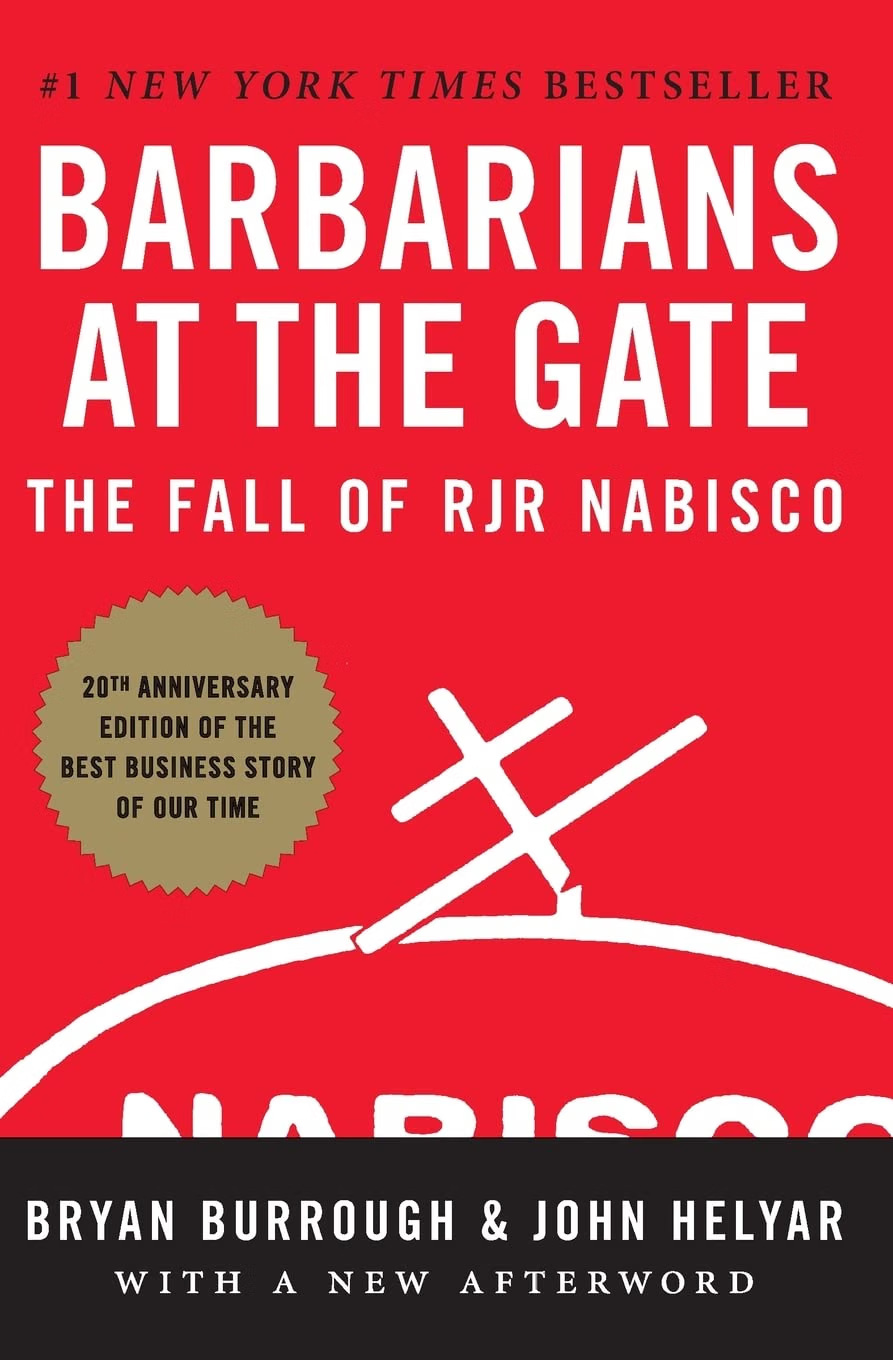
Like Blackboard before it, Instructure became a ping-pong ball in this financial game. It was acquired by PE firm Thoma Bravo in 2020, which then cashed out in an IPO in 2021 as the pandemic made the company’s value on paper soar. Three years later, the public company was bought out by a PE firm. This time it was KKR, famous as the “barbarians at the gate” from the book and movie. They were the original wizards of leveraged buyouts and private equity.
Twenty-five years ago, I started using a course management system called WebCT. I still remember how nice it was to give up hauling all that paper around from class to class. Today, I use Canvas for pretty much the same things I used WebCT to do: post an online syllabus and assignments, keep an online calendar for deadlines, and distribute student papers to be printed and read prior to in-class peer review. Canvas still works fine for all of that, except for when it doesn’t work at all (see #5 below).
But in my day job as an academic technologist, I started hearing about serious problems. To cut costs, Instructure fired experienced educational technologists & account managers and hired new people. New managers and new workers brought a new ethos, one grounded in the startup philosophy that software development is about moving fast and breaking things.
Here are some examples from the past four years of what that looks like:
A new social media-inspired set of emojis was released that provided students new ways to respond to discussion posts. There were no controls for institutions or instructors to turn these off, and so with no warning, teachers and administrators had to post guidelines or take time in class to discuss appropriate use of emojis. This was particularly tricky for those teaching fraught political or psychological topics.
A gradebook update broke a bunch of individual and institutional workflows forcing instructors to submit grades via alternative methods.
A new feature for reporting inappropriate, offensive, or abusive language in discussions was announced. Instructure did not consider what such a reporting mechanism might require in terms of institutional or instructor response. Implementation was delayed, but only after several institutions repeatedly pointed out Instructure’s liability if they moved ahead with their plans.
A steady drip of up-selling new AI features on dashboard pages that it, not the campus system administrators, control. If that doesn’t seem like a big deal imagine that your class policy forbids the use generative AI on assignments, or specifies they use a campus-based AI tool. Then, as they log on to check the assignment deadline, the system encourages them to try these great new Canvas AI features.
The May 2026 Canvas data breach caused an outage, which Instructure resolved by paying a ransom to hackers. If you want to understand how poorly Instructure handled this incident, I recommend reading Phil Hill, especially this piece and this one.
The other side
When I talk to people who work at big educational technology companies, some tell me these examples are just the cost of doing business with Big Tech. Life moves fast, and technology needs to keep up. Better to roll out features and see how they work than slow down, check endless boxes, and consult with every user about every little thing. And sure, paying hackers is a bad look, but data breaches happen. The same hackers hit some universities too, so who among us has the right to throw stones?
I have been told that careful planning and testing are not how things work anymore. Fine-grained controls for institutions and instructors are luxuries, letting teachers or system administrators turn on and off features raises costs. To realize the value of scaling software across thousands of schools and colleges using a single platform, institutions must standardize how learning is delivered. In other words, teachers and students need to adapt their work to use the tools. The alternative is to pay a lot more for the product.
This account, even when it is offered in good faith, obscures how companies put extracting value to increase earnings ahead of serving customers. Moving fast and breaking things is a strategy for transferring the cost of developing new features or protecting sensitive data to institutions and customers. When disaster strikes because a feature release wasn’t thoroughly tested or experienced developers have been fired, the corporate communication team is ready with anodyne statements designed to deflect attention until the crisis is over.
You might say that capitalism has an answer to this problem: when Big Tech fails, go hire little tech. That is certainly what I believed in 2014. I argued that a well-functioning, competitive capital market in educational technology is key to an ecosystem that serves public education. Startups disrupting incumbents, just as Canvas disrupted Blackboard, is how capital markets are supposed to work.
Here’s the problem, now clearly visible in 2026. The system is not well-functioning, nor is it competitive. These days all the founders are playing the same game as the incumbent CEOs, and many of them hope AI disrupts public education right out of existence. They don’t say it anymore because they found out it does not poll well, but their aspirations are for AI to disrupt all human labor. Two startups, Anthropic and OpenAI, and a few old ones like Facebook and Google, that became megacorporations are moving fast to build machines that replace people and break digital systems.
The ball revealed
In 2011, the choice was between an extractive platform behemoth in private hands or a fragile open source consortium with the best of intentions. Canvas looked like a way out. But what happened instead is that the game got bigger. Competition was drowned in an ocean of money. Every founder now looks to get acqui-hired or IPO their way into a giant payout. Every Silicon Valley technology company is building AI as fast as possible. The goal has become something larger and darker than profits.
Earlier, I called Instructure a ping-pong ball, but that’s not quite right. Instructure is a paddle that is used by both the public and the private sides of the capital markets game. Any startup that has a decent shot at success gets funded by the same giant reservoirs of capital that flow through Silicon Valley giants. A paddle is a paddle, whether it is in private or public hands. Schools and colleges, hospitals and youth sports leagues, people and their old systems, just get ping-ponged around the table.
So, what’s the answer? The election earlier this month may be reason to hope that that the AI buildout may slow and that tax laws will change such that the PE game is no longer quite so easy or profitable. Much attention goes to advocating policy interventions at the national level. And sure, citizens should advocate for change and federal government policy matters. But public education is mostly structured at the local and state level. Teachers and students can brace their institutions to stand up to giant corporations. Decisions about what technology to buy and from what companies are made by people you know, or might come to know.
A modest request
The best answer I can offer is to ask you to engage. Talk to your system administrators, your academic technology bureaucrats, your provost and deans, your faculty senate and student government committees. Talk to them about the decisions your institutions needs to make, and not just about AI. Digital technologies are all deeply entangled, a messy complex of solutions and problems born of networked, electronic computers, huge amounts of data, and half-understood advances in computer science. Every decision about AI on your campus is directly related to to choices made about the digital platforms in use, and vice versa.
The technology stories making headlines are playing out in smaller ways at school systems and college campuses. Aging digital infrastructure, cloud-based applications going down, and changes in the ownership structure of technology companies are topics in budget planning meetings at your institution. Get involved. Instead of complaining about losing access to your email for a day, ask questions about how much money is being spent on contracts with megacorporations. Instead of venting about how hard AI is making your job, ask what open source and open weight AI models are available on your campus. If there are such models, try them out in your teaching or research. If there are not, ask why.
I started writing this essay while reading You Are Protesting the Wrong Technology, People! by Hollis Robbins, which struck me as insightful about Canvas and blind to the deep connection between digital platforms and AI. My thinking was further shaped by exchanges on Notes and comments with John Warner and Shreeharsh Kelkar.
Substack is a place where I get to interact with thoughtful people, but it tries to turn writers into ping-pong balls. So, I try to keep a clear head about my relationship to the platform that publishes my writing. My attitude toward Substack pretty much matches how I think colleges and universities should approach the digital platforms they rely on.
Here are three suggestions for how you might think about grabbing a paddle:
Prepare for things to get shittier. Understand how the incentives of the software industry and the role that private equity will lead to digital technology products getting worse over time. Broken public markets means campuses need to constantly evaluate whether the costs to switch are worth paying and what options are available. What’s that evaluation process at your institution? Who is exploring alternatives?

Be ready to move. I have all my posts backed up and have a plan ready to move AI Log to Patreon or Beehive as soon as I decide I’m done with Substack. Does your institution have a plan B when Instructure raises the annual price for using Canvas or it goes down again during exams?
Put pluralism into practice. As a writer and a teacher, I know what I want out of the digital tools I use. And while I value hearing about alternative approaches, including those with strong views contrary to my own, I don’t think anyone knows enough about what I’m trying to accomplish to dictate how I should use AI models or any other digital tool.

My goal is not for you to enact my preferred solutions in your teaching, and yours should not be for me to adopt your methods. The goal is to create space to talk, disagree, experiment, and explore, and to do so with educational values as our guide and digital technology as tools we can use for our purposes or not at all. I am very fortunate to have the freedom I have in the classroom, and I want it for every teacher.
Are those answers? Probably not ones that many people find satisfying. Yet, I believe that large AI models are learning systems that we do not yet understand how to use well or safely. If that’s true, then they are too important to leave in the hands of people running startups. Better to bring the development of this technology into public institutions designed for research and teaching. Research universities are much safer environments for inquiry into and testing dangerous technology. After all, they’re the ones with laboratories for studying viruses and nuclear energy.
AI Log, LLC. ©2026 All rights reserved.
The companies that sell these systems call them learning management systems, often abbreviated as LMS, and like a lot of marketing terms, it caught on.
No one is delighted by digital educational technology. For most teachers, a course information system is like a public toilet: you just want it to work and not be gross. When it malfunctions, people get mad. If that keeps happening, it’s time to replace the toilet.
I was constantly asked for metrics on academic technology projects. The key metric for moving to a new academic information system is not about return on investment or improved test scores. It is how many students and teachers are angry or upset about the change. When we completed the switch to Canvas, that number was roughly zero. It has increased every year since.
Excellent piece about implementation decisions and the ed-tech marketplace. Thank you for writing. My anti-Canvas piece is not "blind" to this but rather I'm asking a different question. Your piece mentions the year 2011 four times! What is so special about 2011? Why, that's the birth-year of "learning outcomes" at scale, the year the Lumina Foundation released the beta version of the Degree Qualifications Profile (DQP) defining what students should know, in handy format for every faculty syllabus across the nation.
My point is that the Learning Outcomes era and the Learning Management Software era are intertwined. The battle between Blackboard and Canvas was a battle between guillotine manufacturers. They are both designed to cut the head off faculty and scale a kind of teaching and assessment based on learning outcomes rather than specific faculty expertise, essential to building the transfer industrial complex that is killing public higher education today.
AI has nothing to do with the current Learning Outcomes regime. AI could end it. That's my position. And this is the right debate to have !