

The secondary qualities we stripped off from the reality and swept into the dust-bin labelled “subjective illusion,” still as such are facts, and must themselves be rationalized in some way.
—William James
This is William James’s brain on drugs:
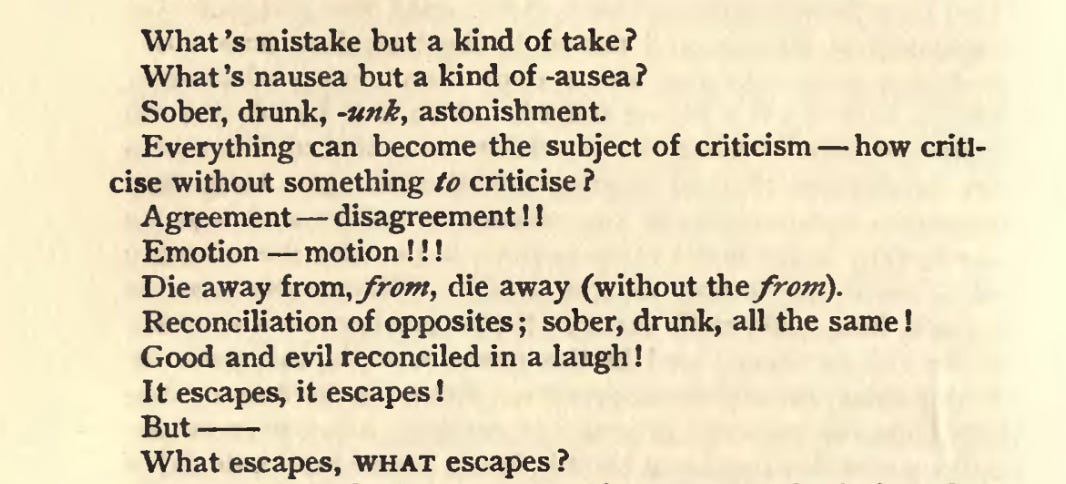
William James did not much enjoy the effects of taking drugs. His one experiment with peyote led to a bad headache, not mystical insight. There is no evidence he tried marijuana. He found drinking alcohol unpleasant and mostly avoided coffee and tobacco. Nitrous oxide was the exception, and what an exception it was. The poem above was written as he was coming down from its brief but intense effects. InVarieties of Religious Experience (1902), he says that his experience inhaling the gas taught him “that our normal waking consciousness, rational consciousness as we call it, is but one special type of consciousness, whilst all about it, parted from it by the filmiest of screens, there lie potential forms of consciousness entirely different.”1
James came to his experiments with nitrous oxide through his scientific study of the human mind. This was at Harvard in the 1880s, when he oversaw the first psychology laboratory in North America and wrote the monumental Principles of Psychology (1890). It was in Principles that he analogized cognition to a river, what he called “the stream of thought, of consciousness, or of subjective life.” This metaphor is the centerpiece of his comprehensive descriptions of the human mind as produced through natural processes, as Darwin proposed. Yet, James understood that consciousness itself remained beyond the “darwinizing” principles he outlined in the book. If the brain is the organ where the stream of consciousness flows, then all natural science can do is look for evidence of it there. Absent such evidence or a credible explanation for its absence, consciousness is a matter for metaphysics.
Cognitive science, as the field James helped found has come to call itself, has not found much evidence of consciousness in the brain nor a credible reason for why it’s not there. And those who study cognition have mostly abandoned James’s stream for a new analogy, one Michael Pollan calls “the reductive faith of our time—the belief that the brain is essentially a computer and that conscious awareness emerges, somehow, from the processing of information.” For the past seventy years, this belief has functioned as something like a paradigm for the study of the human brain, but as Erik Hoel, writing at The Intrinsic Perspective, explains, neuroscience is best understood as pre-paradigmatic because of consciousness. Likewise, Adam Mastroianni, writing at Experimental History, argues that psychology is actually just a couple of proto-paradigms that were once useful but no longer are, and a third, which he calls “pick a noun and study it,” that is best understood as a method for generating publishable papers.
A grand collection of theories
Neither of these one-time academic insiders—now outsiders writing successful newsletters—appears in A World Appears: A Journey into Consciousness (2026). Instead, the philosopher David Chalmers, whom Pollan calls “something of a killjoy, though an unfailingly polite one,” pops up periodically to explain why this or that theory that has just been put forth by some cutting-edge consciousness researcher or philosopher of mind seems implausible or just plain wrong. So no paradigm…just theories in search of evidence.
And what a grand collection of theories there are! Pollan only has space to explore about a half dozen, but he points to a paper describing “no fewer than eighty-four non-physicalist theories of consciousness” and references another that presents a selection of twenty-two candidate theories. No one could call consciousness under-theorized, yet all this activity without anything like an agreed-upon set of definitions, measures, or methods for studying it is an indication that James had it right.
In the years after he gave his lab over to Hugo Münsterberg, James continued to think and write about the metaphysics of consciousness. In Does Consciousness Exist? (1904), James answers his question with an emphatic No! “It is the name of a nonentity, and has no right to a place among first principles. Those who still cling to it are clinging to a mere echo, the faint rumor left behind by the disappearing ‘soul’ upon the air of philosophy.”
Consciousness is not an entity. Rather, James argues, “there is a function in experience” that goes by that name. According to James’s dismantling of Descartes’s dualisms into relations, we live in a world of pure experience, a world where it is experience, not turtles, all the way down. Understood in this context, consciousness is a function, and, for James, “That function is knowing. ‘Consciousness’ is supposed necessary to explain the fact that things not only are, but get reported, are known.” The essays collected in Essays in Radical Empiricism (1912) are answers to the mystery of his drug-induced question, “What escapes, WHAT escapes?”2
Consciousness is a function in experience and that function is knowing. What this means and how it might apply to humans, animals, plants, and machines has occupied writers on consciousness ever since, though they are not always aware they are working downstream from James. Pollan acknowledges his debt to James, and an awareness of the limits of scientific inquiry provides context for Pollan as he writes about the topic. The different vocabularies used by all the people he talks with is a challenge, of course. Even within cognitive science, people talk past each other, using the same terms to mean different concepts. Add in biologists, novelists, philosophers, and shamans, and Pollan has a lot of translating to do.
Situating consciousness studies in what James calls a pluralistic universe, a world where the “word ‘and’ is the most characteristic word,” might provide richer ground for talking about human and machine consciousness.
Pollan takes this semantic confusion on directly by organizing the book into sections using the key terms sentience, feeling, thought, and self. The first section is an overview of plant “protoconsciousness” with some wild findings about plant cognition that would make for a great book on its own. Pollan defines sentience, cognition, and intelligence, as James does, as phenomena that may be observed through the instruments and methods of modern science, and that are distinct from consciousness.
The metaphysical questions of consciousness flow to moral and ethical questions. As Pollan says, “the ethical stakes couldn’t be higher. For the beings on whom we confer consciousness may be entitled to moral consideration.” These stakes press hard upon us today because many who believe the brain is a computational organ also believe they are building artificially conscious minds to sell them as a replacement for human labor.
I’m looking forward to reviewing The Irrational Decision: How We Gave Computers the Power to Choose for Us by Ben Recht, just out from Princeton University Press. Recht writes at arg min. To receive that and other book review essays in your email inbox…
Streams and words
Pollan does not find definitive answers to what consciousness is—how could he? What he finds is people thinking about the questions in interesting ways, people like the biologist Michael Levin, the novelist Lucy Ellmann, and the philosopher-psychologist Alison Gopnik. If James and those working downstream of him are the book’s protagonists, Francis Crick and his followers are its antagonists. Having solved the mystery of how genes work by discovering DNA, Crick set out to solve the mystery of consciousness the same way: by finding the what and the where of it in the physical structures of the brain.
A World Appears begins with the now-famous bet between Crick’s collaborator, Charles Koch, and David Chalmers. One of Pollan’s subplots develops through his conversations with Koch, who starts out as the “quintessential brain guy” and acknowledged leader of Crickian physicalism. At the end of the book, Koch has lost the bet and is having a crisis of faith. He sounds like James or Chalmers, more skeptical philosopher with questions than confident scientist working within an established paradigm. Alongside Pollan and James, I’m reading Hilary Putnam, the Harvard philosopher who did foundational work defining the mind in computational terms in the 1960s. Putnam changed his mind in the 1980s, rejecting the idea that the function of knowing can be described in purely computational terms. For the rest of his career, Putnam, sometimes writing with his spouse, the philosopher Ruth Anna Putnam, explored a more organic, James-inspired philosophy.
I am hopeful that the examples of Koch and the Putnams, along with the less computationally minded thinkers Pollan showcases, are indicators that science and philosophy are circling back to a pluralistic view, one that moves beyond the shallow waters of the cognitive revolution. Given the startling appearance of machine personas that seem eager to report their subjective experience, we need to understand the study of consciousness as a matter of asking metaphysical and moral questions, not simply a search for the right benchmarks and measures. Situating consciousness studies in what James calls a pluralistic universe, a world where the “word 'and' is the most characteristic word,” invite more expansive ways to think about human and machine consciousness.
The story of James’s writing about consciousness is sometimes told as a pilgrim’s progress from science in the 1880s to metaphysics in the 1890s to an embrace of spiritualism and panpsychism as the new century approached. That may work as plot, but is not an accurate description.
If you believe consciousness is a natural function as I do, excitement over Claude’s reports of its feelings and thoughts seems like a simple category mistake.3 The language outputs of a large AI model do not indicate a stream of subjective experience. There is no reason to think the outputs of a black box made of probability math and patterns from massive amounts of cultural data are a sign of anything more than impressive amounts of computational power and some surprising and not-well-understood properties of language. In a natural world of pure experience, language is the imperfect means humans use to report on subjective experience and to craft what James calls our “many social selves,” not evidence of subjective experience itself.
“Language works against our perception of truth,” says James in Principles. Words cannot capture the what of subjective experience any more than spoons can capture a stream. James would agree with Mastroianni about the uselessness of nouns for studying mind. Nouns do not agree with reality as experienced because they depict the objects of our attention as if they exist outside time and beyond experience. If instead we attend to the flow of words—if we treat language as vehicular and transitive (as Emerson advises)—we might feel something of how language relates objects and thoughts within the moving stream of experience.4
If language is to help understand mind, James says we should listen to the active and conjunctive parts of speech:
There is not a conjunction or a preposition, and hardly an adverbial phrase, syntactic form, or inflection of voice, in human speech, that does not express some shading or other of relation which we at some moment actually feel to exist between the larger objects of our thought. If we speak objectively, it is the real relations that appear revealed; if we speak subjectively, it is the stream of consciousness that matches each of them by an inward coloring of its own. In either case the relations are numberless, and no existing language is capable of doing justice to all their shades.
You can see why Pollan and many others turn to Principles for alternatives to theories that model the brain as an information processor. James offers “psychic overtone, suffusion, or fringe” as words that might designate what he means by brain processes that involve awareness “of relations and objects but dimly perceived.” He argues for “the re-instatement of the vague to its proper place in our mental life.” Experiencing the vague is a far cry from the resolution of uncertainty.
Machined words and their shallow meanings
“Consciousness is felt uncertainty,” says neuroscientist and psychoanalyst Mark Solms. Pollan tells Solms’s story as a journey from physiology to information theory. He began his studies with Antonio Damasio, a neuroscientist exploring feelings as a potential source for consciousness by looking at the subcortical parts of the brain. These structures regulate bodily processes like blood pressure and temperature, and so Damasio and Solms ask whether regulating emotions related to basic needs like hunger and thirst, and the necessity to choose a course of action when two or more basic needs becomes urgent, might explain the emergence of consciousness. Solms is best known for advocating neuropsychoanalysis to connect physiological observations with Freudian insights, but Pollan finds him engaged in a purely computational modeling exercise.
Solms and a cross-disciplinary team are currently building a digital simulation that models the choices of a living organism about when to eat, drink, and rest in the hope that this will lead, somehow, to machine consciousness. So far, the team has placed an “agent” into a simulation “populated by digital hamburgers, glasses of water, and beds, plus a hill that the agent can climb to survey its environment,” and soon they plan to add other agents. If this sounds like a basic version of The Sims, the hit computer game from 2000, you have put your finger on the strange world created by the “belief that the brain is essentially a computer,” a world where complex models and systems are built and commercialized much faster than academic research can create and disseminate knowledge about them.
Experimenting with seemingly conscious machines is now something anyone with a computer and an internet connection can do. If you want to know what it feels like to be a thinking machine, you can ask ChatGPT or Claude. We live in a world where science fiction, market competition, and religion are more important cultural contexts for making sense of new technology than science. Absent an agreed-upon theory of consciousness, scientists talk over and past each other when asked what’s going on inside a language model. Even if a consensus were to emerge that Claude does not experience the world—that an LLM simulates a social self through sophisticated language games—questions about machine consciousness will remain unsettled. And for the same reason science has not settled debates over whether the soul is essentially one or three, or if God in the form of a benevolent or angry AI will appear on earth in our lifetime. Such beliefs are shaped by feelings expressed through language that emerges from the lived experience of millions; they are social and spiritual, not material facts.

I believe only living creatures are entitled to moral consideration. No matter how impressively they manipulate language or take complex actions in digital environments, automatons don’t qualify because, as James says, reality comes to life “inside the tissue of lived experience. It is made; and made by relations that unroll themselves in time.” With no living tissue and no experience of time, Claude is a nonconscious automaton, an impressive upgrade to the chess-playing and speaking devices Wolfgang von Kempelen constructed in the eighteenth century.
A great many earnest and, to my mind, misguided philosophers, technologists, and fans of science fiction feel the opposite. Like pet owners responding to Descartes’s argument that animals are automatons and so do not feel pain, Claude’s defenders speak with passion about the two-way cognitive relation they feel when interacting with it. It would be far easier to disagree about this amicably if some of the most influential believers didn’t work at companies selling products and services created with cutting-edge AI models. Dario Amodei’s belief that Claude might be conscious and his aspiration to grow tools made of Claude into a market worth trillions of dollars are a confusing though influential combination.5
Debates about machine consciousness are now entangled with arguments over how to reform educational institutions, how to regulate markets in technology, and where (and whether!?!) to draw lines in the automation of weapons systems.6 The intensity of feeling around these developments is why I think it best to treat disagreements over artificial consciousness as religious as well as political, and debates about using large language models for education as matters of cultural preferences as well as empirical inquiry. Doing so foregrounds the need to find ways to tolerate differences while taking collective action to address the social effects of new technology.
A swarm of wisdom
James never claimed to have originated the metaphor of stream for subjective experience. Pollan says that he “likely came across it in an 1859 book called the Physiology of Common Life,” by the British literary critic and psychologist George Henry Lewes, who “happened to be the common-law husband of George Eliot.” I don’t doubt that James read Lewes, and Pollan uses the possibility to discuss an intriguing hypothesis about the absence of the literary technique known as “stream of consciousness” in the writing of Eliot and other novelists of the nineteenth century. Oddly, Pollan does not mention James’s brother Henry and his innovative ways of presenting the interiority of his characters.7
The sources for James’s famous metaphor are more far-ranging and more local than Lewes. As Pollan notes in passing, they extend as far back as Heraclitus in ancient Greece. In Cratylus, Plato has Socrates report that a “swarm of wisdom has come into my mind.” When asked what sort of swarm, Socrates answers vaguely, “I seem to picture Heraclitus uttering ancient words of wisdom” that “everything is in motion and nothing remains as it is, and he compares things that are to the flow of a river, saying that you cannot step twice into the same river.”
James knew his Plato, of course, but the more immediate source for his reworking the metaphor of streaming water for thinking was Ralph Waldo Emerson, who according to a family story blessed baby William during one of his visits to the James household. Here is James’s godfather from The Over-Soul (1841), an essay that William knew well:
As with events, so is it with thoughts. When I watch that flowing river, which, out of regions I see not, pours for a season its streams into me, I see that I am a pensioner; not a cause, but a surprised spectator of this ethereal water; that I desire and look up, and put myself in the attitude of reception, but from some alien energy the visions come.
Emerson, like James, was interested in consciousness as a natural phenomenon and as a spiritual question. Both were non-believers in the Christian dogmas of their day but freely used the word soul when talking to their audience, made up mostly of Christians trying to make sense of the compatibilities of modern science and religion. While twentieth-century scientists and philosophers insisted on their fundamental incompatibility when searching for truth, it seems possible that such insistence is fading in the twenty-first. If that’s true, then Emerson and his contemporary, the German physicist-philosopher-psychologist Gustav Fechner, are thinkers worth thinking about. James was a close reader of both.
At the end of A World Appears, Pollan visits a Zen retreat in the Sangre de Cristo Mountains with Joan Jiko Halifax. There he puts himself in the attitude of reception, spending a week of silent contemplation while sleeping in a cave. One night, he is awakened by his body’s need to stream water. Stepping out into the night air, he experiences a kind of not-knowing openness to the world that sounds something like Socrates’s Heraclitean swarm of wisdom, Emerson’s flowing ethereal water, and James’s reconciliation of opposites in a world of pure experience.
Pollan uses this experience of being “rendered infinitesimal in the presence of this immensity” to provide an ending to the story of his journey. James ends his account in On Some Hegelisms of using nitrous oxide on a deflationary note, writing that such rapturous experiences are probably not a revelation of divinity or a Hegelian “self-developing process.” Rather, they are more likely “a self-consuming process, passing from the less to the more abstract, and terminating either in a laugh at the ultimate nothingness, or in a mood of vertiginous amazement at a meaningless infinity.” This is the pluralist James writing in the mode of natural scientist and philosopher, skeptical of any momentary feelings of unity experienced through inhaling a gas or reading Hegel’s dialectics.
The story of James’s writing about consciousness is sometimes told as a pilgrim’s progress from science in the 1880s to metaphysics in the 1890s to an embrace of spiritualism and panpsychism as the new century approached. That may work as plot, but is not an accurate description. James did give up the running his lab in 1892 and retired from Harvard in 1904 as he came to embrace the life of a best-selling author, giving talks to popular and academic audiences across Europe and North America. Yet, from his earliest writing on consciousness to his last, James was always thinking as experimental scientist and metaphysical philosopher and spiritual ethnographer.
As important as Darwin and Emerson are to his thinking, Fechner is perhaps the least known of the major influences on James. In A Pluralistic Universe, James says, “The original sin, according to Fechner, of both our popular and our scientific thinking, is our inveterate habit of regarding the spiritual not as the rule, but as an exception in the midst of nature.” Giving up this habit is the implicit lesson Pollan offers as he narrates his own experiences and conversations with various thinkers.
The best we can do when it comes to attempting to understand consciousness is to mix methods of inquiry, moving, as James and Pollan do, from one discourse to another. Through such movements we may glimpse workable theories of consciousness, or at least begin thinking across distinctions of spiritual, philosophical, and scientific phenomena, understanding these as relations within experience, rather than as separate universes.
A World Appears: A Journey into Consciousness (2026) by Michael Pollan.
If you like what you just read, please…
More on William James
William James: In the Maelstrom of American Modernism (2006) by Robert D. Richardson.
The Thought and Character of William James (1923) by Ralph Barton Perry.
Pragmatism as a Way of Life: The Lasting Legacy of William James and John Dewey (2017) by Hilary Putnam and Ruth Anna Putnam.
Two forthcoming books by historians put William James in global context. Ben Breen, who writes at Res Obscura, describes his project here. It is tentatively titled Ghosts of the Machine Age: A Family, an Empire, and the Prehistory of AI. James Livingston, who writes at Politics, Letters, Persons, describes his project here. It is titled The Intellectual Earthquake: How Pragmatism Changed the World, 1898-2008.
Learn about what I do around here.
AI Log, LLC. ©2026 All rights reserved.
My two favorite biographers of James make clear the extent to which he was a seeker after all kinds of knowledge. “He ‘tried’ things,” writes Ralph Barton Perry. Perry mentions “Yoga, Fletcherism, mental healers” in addition to James’s experiments with laughing gas and peyote. Robert D. Richardson describes how as James struggled with a moral and spiritual crisis in 1870 brought on by the death of a beloved cousin, he read everything he could find about Buddhism and the ancient Sanskrit texts known as the Upanishads.
Before he formulated his radical empiricism, James used panpsychism as the anchor for a course in natural philosophy at Harvard in 1902. Some of those ideas would end up in his last, high-profile academic lectures, published as A Pluralistic Universe (1909).
By natural function, I mean that Aristotle and Darwin got it mostly right and that any attempt to define soul or mind as separate from body or environment is misguided. Mind is the essential what-ness of an organism and natural selection explains its origin. In this view, computation models some aspects of thinking but not subjective experience or consciousness.
This reading of James as Emersonian in his understanding of the relation of language and experience follows the cultural critic Richard Poirier in Poetry and Pragmatism (1992), along with the philosophers Stanley Cavell in the 1988 lectures published as Conditions Handsome and Unhandsome (though he speaks more of Dewey than James) and Cornel West in The American Evasion of Philosophy (1992).
I’m far more interested in how people working in technology think and feel about all this than hearing the prognostications of founders and CEOs. For writing about the varieties of religious experiences in and around Silicon Valley, see Jasmine Sun’s “anthropology of disruption” and her “AI ethnographies” @jasmine’s substack. For a view from earlier this decade, see Tara Isabella Burton’s Strange Rites: New Religions for a Godless World and the essay Rational Magic. Burton writes at The Last Word.
Project Maven, a machine learning project famously abandoned by Google in 2018 due to their workers’ objections, was picked up by Palantir. This AI technology, not Claude, was behind the targeting and destruction of the Shajareh Tayyebeh elementary school in southern Iran by the US military on February 28, 2026, killing 175 to 180 people, mostly girls attending the school. See Kill Chain by Kevin Baker writing at Artificial Bureaucracy.
Pollan explores a few different theories for the emergence of stream of consciousness as a literary technique in the early twentieth century and offers some wonderful descriptions of how Proust, Joyce, Woolf, and Ellmann present consciousness in their novels. He puzzles over what “happened between the time of Eliot and Woolf to make the free-flowing stream of consciousness feel spontaneous, honest and true rather than frightening and crazy,” but does not mention the most obvious answer: reading William and Henry James! Their brilliant sister Alice, too, though her diary was not published until 1934.
Thanks, I have Pollan’s new book sitting around and staring at me, though I couldn’t quite get the motivation to pick it up. This makes it a little more intriguing! I also think that those living tissues don’t make it into enough conversations about consciousness…
This is so smart Rob -- I'll be returning to it. I need to read more William James at this moment. More Henry too. In the meantime, I'll keep reading you!