

Thucydides and Mark Carney are in the news these troubled days, and with them Henry Farrell, the proprietor of Programmable Mutter and co-author of The Underground Empire (2023). The book makes sense of changes in the operations of power in the world, which is why Farrell ended up onThe Ezra Klein Show talking about Carney’s “rupture” speech at Davos, offering analysis that grapples with the complexity of what’s happening. I don’t believe in silver linings where Trump is concerned, but giving Farrell a microphone to offer something significantly more incisive than the usual hot takes was a bit of good in an otherwise miserable month.
In his now-famous speech, Carney quoted the well-known line of Thucydides: “the strong do what they will, while the weak suffer what they must.” Carney’s use of this aphorism suggested that it does not mean what many who quote it think it means. For anyone who is confused, Farrell explains its relevance for making sense, or not, of today’s world disorder.1

Farrell is a compelling writer on the subject of big information systems in world politics and on the big information systems we call large language models. That breadth is a testament to his approach to intellectual work: he is a collaborator’s collaborator, a practitioner of what Brian Eno calls scenius.2 Farrell’s production function, as Tyler Cowen would call it, is a model for those of us who cling to solo writing habits and myths of individual genius. Now that Farrell has appeared on Ezra Klein, wouldn’t it be great to hear Farrell and his frequent collaborator Cosmo Shalizi interviewed about AI on Conversations with Tyler?3
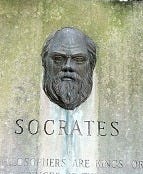
I have nothing to say on the topic of Thucydides and world events that isn’t being said better by more knowledgeable writers, but misreadings of the Melian Dialogue remind me of another dialogue, Plato’s Phaedrus. This one is quoted frequently in the context of AI and education, usually to make the point that smart people have always taken a skeptical view of new writing technologies.
Though he does not use the terms “cognitive offloading” and “metacognition,” the lines Plato wrote around 370 BC speak directly to fears of educators about AI. Replace “soul” with “mind,” and the line that writing “will introduce forgetfulness into the soul of those who learn it” could be a teacher today talking about students using ChatGPT. 4
Likewise, replace “writing” with “LLMs” in this passage:
They will not practice using their memory because they will put their trust in writing, which is external and depends on signs that belong to others, instead of trying to remember from the inside, completely on their own.
Socrates sounds like he is talking to Sal Khan or some all-in-for-AI professor:
you provide your students with the appearance of wisdom, not its reality. Your invention will enable them to hear many things without being properly taught, and they will imagine that they have come to know much while for the most part they will know nothing. And they will be difficult to get along with, since they will merely appear to be wise instead of really being so.
I wrote an essay last summer about Walter Ong’s talk, titledWriting Is a Technology That Restructures Thought, an update to Chapter 4 of Orality and Literacy. He reads Phaedrus as a story about the “invaluable intrusion of writing into the early human lifeworld,” an intrusion Ong compares to the much more recent intrusion of the computer.
A Phaedrus Moment

What is seldom if ever noticed, however, is that Plato's objections against writing are essentially the very same objections commonly urged today against computers by those who object to them.
Reading Phaedrus, one comes to understand that there is more to Socrates’s thinking than skepticism. He is teaching thinkers about how to approach written text, not arguing for illiteracy. Read Danielle Allen’s Why Plato Wrote (online here). Read the Roland Barthes essay, L'Ancienne Rhétorique, which appeared in English translation in The Semiotic Challenge. Even better, read Phaedrus itself.
You will find that Socrates speaks these lines in his telling of a mythic story about the invention of writing. He is relating the words of the human king, Theuth, to Thamus, writing’s god-inventor. The audience for this story is Phaedrus, a student who prompted Socrates by expressing his enthusiasm for a new speech by Lysias. Phaedrus has a written copy of the speech, and their conversation begins with Socrates persuading Phaedrus to read the speech aloud.
The scene is complex. The setting is a walk through the countryside (unusual for Plato), and the rivalry between Socrates and Lysias for Phaedrus’s attention forms the backdrop. As the dialogue unfolds, dramatic and philosophical tensions around the meanings of love and friendship (eros and philia) are the primary topic. Writing is only addressed toward the end of their talk, and it is in the context of relations between teachers and students, including Socrates’s with Phaedrus and, in the background, Socrates’s with Plato
Socrates’s concluding thoughts on writing are that this technology, at its best, “can only serve as reminders to those who already know.” Such reminders are useful, but only if they “are composed with knowledge of the truth,” if you, the writer, “can defend your writing when you are challenged, and if you can yourself make the argument that your writing is of little worth.” In other words, treat writing as a path to knowing, not as a method to store truth.
In a passage worth reading carefully, Socrates speaks favorably of forms of writing “that plainly declare their allegiance to live dialectic,” to use Danielle Allen’s phrase, like the dialogue form his students developed to honor their teacher’s methods. Plato writes that a person who feels the limitations of written language, “thinks that only what is said for the sake of understanding and learning, what is truly written in the soul concerning what is just, noble, and good can be clear, perfect, and worth serious attention.” The question to ask is what could he mean by “written in the soul”?5
Words, whether they are produced by vocal cords, or hands manipulating a quill or keyboard, become meaningful in the context of the human lifeworld. Knowledge is produced through social processes, and it can be embedded in tools that are external and depend on signs that belong to others. The intrusion of this new writing technology, these latest language machines, into our lifeworld, seems inevitable. We must accept these tools on the terms that their corporate inventors are offering them. That’s usually the point of repeating the famous lines from Phaedrus: The message: Look, Socrates resisted writing, but see what happened? Writing happened. Now, get with the program.
Mark Carney’s stunning speech includes the line, in English translation: “The power of the less powerful begins with honesty.” He then presents the line: “the strong do what they will, while the weak suffer what they must.” Carney says that the aphorism “is presented as inevitable” and its logic seems to demand compliance with the strong in the hope the rest of us can avoid the trouble of being singled out. We accommodate power, herding together, in “hope that compliance will buy safety.”
In the rest of the speech, Carney speaks honestly that the circumstances we find ourselves in are fixed and the logic of accommodation to power is presented as unassailable, how we respond is up to us. Our options are constrained, but that does not mean we have no choices. He says, “To help solve global problems, we are pursuing variable geometry,” a wonderful metaphor for taking thoughtful action, for thinking beyond the shape of what what is presented as inevitable.
Evitability is not an easy concept for thinking about how we might order the world or develop new cultural technologies. It helps, I think, to revisit conventional wisdom, ideas frozen in passages repeated without context. Done well, reading may lead us to truly write new thoughts into our collective understanding of what “is just, noble, and good,” and, as Carney did, make words that are “clear, perfect, and worth serious attention.”
Done badly…well, think about the role that words reproduced using the printing press have played in human conflict and violence in the centuries after it was invented. The technologies we use to order and reorder words are as powerful, and as dangerous, as those we use to order and reorder atoms.
The lesson Socrates teaches Phaedrus is that reading and writing well is a matter of using external tools to think wisely, not treating them as stores of wisdom. That lesson applies when we read Thucydides and Plato, and when we approach new technologies of writing as they intrude upon our lifeworld.
To receive essays like this one in your email inbox once or twice a month, click this button.
Here is an annotated list of writers who, like Farrell, who are writing and thinking toward evitable futures in the context of artificial intelligence.
AI Log, LLC. ©2026 All rights reserved.
At Kevin Munger’s recommendation, I’ve been reading Vilém Flusser’s Does Writing Have a Future? It was first published around the time Ong’s Writing Is a Technology That Restructures Thought appeared in The Written Word: Literacy in Transition, ed. Gerd Baumann (Oxford: Clarendon Press, 1986). Both essays helped me think about writing technology across time and both have been useful in thinking about these latest language machines, more useful than most of what I have read about AI in the past few years.
Flusser is still largely unknown to English speakers. His major works were unavailable in English translation until 2011. Worse, they have the funky odor of “continental” philosophy. Yet, even those who wrinkle their nose at Foucault and Derrida may find his writing worth trying.
Here’s a taste of Does Writing Have a Future?:
All writing is orderly, and that leads directly to the contemporary crisis in writing. For there is something mechanical about the ordering, the rows, and machines do this better than people do. One can leave writing, this ordering of signs, to machines. I do not mean the sort of machines we already know, for they still require a human being who, by pressing keys arranged on a keyboard, orders textual signs into lines according to rules. I mean grammar machines, artificial intelligences that take care of this order on their own. Such machines fundamentally perform not only a grammatical but also a thinking function, and as we consider the future of writing and of thinking as such, this might well give us pause for thought.
If you are new to Farrell’s writing on AI, this essay is a good place to start, as is his collaboration with Alison Gopnik, James Evans, and Cosmo Shalizi: Large AI models are cultural and social technologies.
Although the essays he posts on Programmable Mutter and his latest scholarly essay, AI as Governance in the Annual Review of Political Science, were written solo, nearly all of his scholarly writing is co-authored.
The recent appearance of Alison Gopnik on Cowen’s podcast was disappointing due to his uncharacteristic refusal to entertain the premises of her explanation of generative AI as cultural technology. Cowen’s stubborn attachment to the notion that large language models are generally intelligent seems to have closed his mind to alternative views. What could have been a conversation across difference ended up a rare case of him shutting down a conversation.
All quotes from Phaedrus are from the Nehamas & Woodruff Edition, 1995. Hackett Publishing Company, 274c-278c.
Bob Dylan’s answer is in his reference to Plutarch’s Parallel Lives inTangled Up In Blue.
Then she opened up a book of poems
And handed it to me
Written by an Italian poet
From the thirteenth century
And every one of them words rang true
And glowed like burning coal
Pouring off of every page
Like it was written in my soul
From me to you
Great article. I love those alignments.